Archive for the ‘Wind’ Category

Vestas closes second manufacturing plant in Australia

Wednesday, August 22nd, 2007

Vestas, the world’s biggest wind turbine manufacturer from Denmark, has just announced that it will be closing its last manufacturing plant in Portland, Australia “because the green market there is unviable“. This comes after the Danish-based company last year closed a similar $15 million factory in Tasmania, laying off 65 staff.

You’d think that Australia was the perfect place for wind power - a massive continent with just 20 million people to go around, who could object to the odd windfarm?

These charts taken from the Australian Wind Energy Association website tell the story.

Although cumulatively rising fast, 2006 was a slow year for installation. The other point is Australia has some of the lowest electricity prices in the world and electricity consumption is growing at a staggering 3.2% per annum - amazing for a developed country.

In the medium term it seems that price competitiveness and fast-rising electricity demand, means wind will struggle to make a dent for some time in Australia.

Wind Hydrogen Ltd - seeks to benefit the electricity and chemical industries

Monday, July 23rd, 2007

A few years ago, I much enjoyed reading (although certainly didn’t always agree with) Jeremy Rifkin’s book, “The Hydrogen Economy“. One part though that stuck in my mind was his reference to hydrogen from wind powered electrolysis. On page 189 of the paperback edition he said:

“When wind power drops to 1.5 cents per kilowatt hour in the next few years, electrically generated hydrogen, using wind power, will be competitive with gasoline.”

5 years on, wind power prices - as measured by the installed cost per megawatt - have actually gone up. And even with one of the best sites and the lowest possible installation costs, the levelised cost per kilowatt hour over a 20 year period is still pretty much 5 cents per kilowatt hour, excluding all other externalities (additional transmission lines, grid-reinforcing, load-balancing, avian mortality rates, etc. . . . all of which rise with an increased wind penetration). From today’s standpoint, 1.5 cents a kilowatt hour looks a very long way off.

But the concept is still alive.

That’s why I was intrigued and very grateful to learn from an AEI reader based in New Zealand of a new company seeking to IPO on the Australian Stock Exchange next month (10th August), called Wind Hydrogen Ltd.

The company says it holds international patents over hydrogen-based technology that is complementary to wind power generation, able to overcome the issue of variable output from wind farms, considered a key long-term barrier to the commercialisation of wind power. They also believe their technology opens access to markets for hydrogen and hydrogen-based products. This last bit is important - they think they can sell off the surplus hydrogen to downsteam chemical companies who would otherwise take it from natural gas, releasing CO2, for the production of ammonia.

What I found particularly interesting though is that they have patents pending on wind monitoring and prediction. Combine accurate wind forecasting to an electricity spot market in short supply of power and very quickly you could get a profitable business model.

But hydrogen has to be most expensive form of energy storage so they are dependent - and I suspect taking a bet on - rising and unpredictable gas prices affecting the electricity and chemical industries. Meanwhile, Hydrogenics has just opened a wind-powered hydrogen fuelling station in Dakota.

Wind Hydrogen is definitely a company to watch. Still, the cynic in me thinks if this energy storage is so good, why not combine their storage technology with a fully amortised and rainfall-deprived hydro power plant?

This would be a lot cheaper - and more profitable, as well as renewable.

Vanadium Redox Batteries can ramp up wind energy production

Wednesday, July 4th, 2007

Here is a highly informative and readable article just published by Environmental Health Perspectives on the potential impact of flow batteries on wind energy. I’d have to say - from where we are now, that impact is just possibly massive. And I must admit, I also like the article because they have given me 3 quotes.

On the business case for this type of energy storage though, I have yet to come across an up-front capex figure on the cost of 1 megawatt hour capacity vanadium redox battery - as made by VRB Power Systems. This would make a transparent case for the investment - or not - in windfarms around the world.

As one might expect from an Environmental Health magazine, they were very keen about the low environmental footprint of the technology. These are the greenest of the batteries because they lack potentially toxic metals like “ . . .lead, cadmium, zinc and nickel which can contaminate the the environment at all phases of the conventional battery life cycle”.

I also keep thinking about nanosafe batteries, which can 80% recharge in 1 minute and achieve 15,000 charge/discharge cycles, which compares very favourably to 1,000 for lithium ion.

Energy storage really is making progress, something a couple of years ago I would have dismissed as fantasy. Now it is coming out of the lab and is deploying to the field, I think we may see some even more radical innovation unfold.

Renewable Energy Generation expands in Canada

Thursday, June 14th, 2007

AIM-listed Renewable Energy Generation, a windfarm operator and developer, has ordered a further 18 wind turbines for its Canadian wind farm projects and expects delivery in autumn 2008.

REG logo

The company has other farms in the UK and Poland. But they are a fraction of the size of the estimated 2.5 GW that they could exploit in Canada - much easier to do since they acquired AIM Powergen Corp in August last year. There still isn’t really much windpower in Canada - just under 800 megawatts in capacity in a country voluminous in empty space and plenty of hydropower to back it up. So REG looks strategically well placed in Canada.

And yet I think I’ve said it before, but couldn’t someone have come up with a better name for the company than Renewable Energy Generation?

It’s a bit like calling a computer company, the computer company. It makes it totally impossible to drown out the white noise of non-related information to the company on the internet - very important these days.

Wind turbines and avian mortality rates; what’s the truth?

Wednesday, June 13th, 2007

Slightly off the beaten track from alternative energy stocks, but worth a post. There is an ongoing debate of raging intensity as to how serious the risks of wind turbines are to birds. The technical lingo for this is “avian mortality rate”. No question, it does happen and I have found a picture from this site which I assume is genuine of 2 eagles, in pieces post an encounter with a wind turbine in Spain.

Eagles killed by a wind turbine

Not a pretty site.

But there’s more to it than this. We must have some perspective. Many things kill birds (and for that matter, bats) in far greater numbers - particularly domestic cats and cars, both of which kill millions and millions each year. I’ve yet to hear however of anyone advocating a mass cull of domestic cats to help the birds. What’s more, Industrialised agriculture has probably done more than both of these put together.

The problem comes from the type of birds wind turbines kill - typically slow maturing predator species (eagles) and the emigrating kind (geese). There just isn’t much you can do about this. Eagles like to soar on currents and wind turbines can interfere with this. Some believe putting more turbines out at sea would go a long way to reducing bird kill. That though runs into statistical issues. Avian fatalities are not fully accurate because of scavenger removal - i.e. you can’ t record a dead bird if a fox takes it before you see it. Accounting for scavenger removal becomes a whole lot more difficult out at sea and some would say impossible.

So surely, it is not beyond the wit of man to develop some sort of device that keeps these birds at a safe distance?

Vestas signs long-term carbon fiber agreement with Zoltek

Wednesday, May 30th, 2007

Alternative energy watchers are all too aware of the polysilicon shortage on solar pv. But here’s a similar angle that plays in the wind industry that we don’t hear much about - fibers, the feedstock for turbine blades. And Vestas, the world’s no. 1 wind turbine is taking action by closing a long-term supply deal with Zoltek.

Zoltek expects to provide Vestas with over $300 million of carbon fiber and carbon fiber materials over the first five years of the agreement, for the manufacture of rotor blades for wind turbine generators. Zoltek also anticipates expanding nameplate carbon fiber capacity from 2,800 metric tons in 2005 to 10,800 metric tons by early 2008.

There is a professional difference of opinion over the merits of glass fiber or carbon fibers for wind turbine blades - see this detailed anonymous article which disparages Zoltek (not least because back in April, he was shorting it) here. Zoltek is obviously in the carbon fiber camp and supplies Gamesa as well as Vestas. On the other side exist LM Glasfiber who supply - you guessed it - glass fiber turbine blades to Enercon, GE, Siemens, and Suzlon.

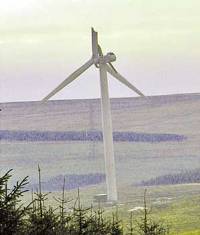
Broken turbine blade

Broken turbine blades are worryingly frequent - perhaps this is ultimately why commercially available turbines cannot seem to surpass a size of 5 MW, because the blades are just not strong enough. If and when that does happen, maybe through nano-engineering, then 40 MW turbines become possible and the price of windpower will plummet like it did in the 1990s again.

Suzlon wins battle for Repower - and illustrates the globalisation in the wind energy industry

Friday, May 25th, 2007

Ok, this is extraordinary news.

A dynamic and successful Indian Wind turbine manufacturer - Suzlon - has outbid a French nuclear company - Areva - for control of a German wind turbine manufacturer - Repower Systems AG.

Talk about chutzpah!

I’ve had my doubts about this deal - I still do. But Suzlon’s rationale behind it is the following;

i) REpower will give Suzlon access to high-value, high-capacity turbines ranging between 1.5-5 MW
ii) These are more likely to generate sales in developed countries
iii) They will also get Repower’s technology for offshore turbines

All of that makes sense enough. Although a distinguished economist I was speaking to recently thought that many takeovers and mergers fail because those firms omitted to conduct an audit of the intellectual property assets. This has often led to an exercise in brand destruction - think of Daimler Chrysler. Mix up high-quality, medium production runs with low-quality, high production runs and what happens to the brand name?

Obviously, this isn’t a like for like comparison. But I tend to think that organic growth is a better path in manufacturing. 2 years from now, we’ll have a much better idea of whether this takeover has really worked - or not.

Suzlon’s final warchest for Repower AG is EUR 1.2 billion

Monday, May 21st, 2007

Suzlon is nothing if not determined to take over Repower Systems AG.

Sources close to the company said it had organised funds worth €625 million (Rs 3,408 crore) through two bridge loans, a €325 million (Rs 1772 crore) 10-month tranche and a €300 million (Rs 1,636 crore) 18-month tranche. ABN Amro is the lead manager for the fund collection.

I’ve been an admirer of Suzlon for some time - there’s something hugely admirable about an Indian firm that turns up and blows a whole lot of competition out of the water, whilst impressing the analysts with its high double-digit margins.

Yet somehow I sense that they are losing focus in their quest for scale - e.g. the interest in solar power and biodiesel, the unwelcomed takeover bid for Repower Systems AG and above all, the declining margins - EBITDA margin stood at 17 per cent at the end of Q4 FY07 against 26 per cent in Q4 FY06.

Vestas wins plaudits for its rising reputation ranking

Monday, May 21st, 2007

FORBES, 21st May: Vestas Wind Systems, has just won high praise from New York’s Reputation Institute, which has just published global reputation rankings of 600 companies, for improving its reputation. Vestas has jumped 25 places for 2007 from 2006 to become the 17th most reputable company in their universe.

A Vestas 3MW turbine

To paraphrase the article . . .

This has been put down to the late flowering of a merger with NEG Micon which didn’t work out well in 2004/2005. Since then, a new CEO and senior leadership team have been put in place and last year was the first time the company turned a profit. Said Kruse, Vice-President of Vestas Communications, the company has also benefited from a global media strategy-instead of focusing communication efforts on Danish media, it’s reaching out to the international media. The company was recently featured in Newsweek, CNN and Bloomberg Television.

Ok, well that secures Kruse’s job then !

Seriously though, I have my doubts about global reputation rankings because unlike profits or losses, a reputation is not actually something you can put a black and white number on. Could you imagine a blue chip accountancy firm doing a reputation audit?

And I’m not too sure about Gazprom - the state-owned Russian hydrocarbon firm and arguably the right arm of President Putin’s foreign policy - jumping 289 places to rank 28th in the world for 2007.

Investment may be an art rather than a science, but reputation is a truly intangible, immeasurable asset. I could just see disproportionate lobbying by PR firms really distorting the picture, which of course they would love to do. My feeling is that alternative energy companies - like any other - would do best to concentrate on making profits. After all, why would any company not choose to have a good reputation?

Suzlon reports Q4 up 22% - and the Repower bid story drags on

Wednesday, May 16th, 2007

Suzlon Energy, the Indian wind turbine manufacturer, has just reported Rs 437.82 crore net profit for Q4 compared to Rs 360.16 crore a year ago. Normally, you’d think this is pretty good, but worse than expected by analysts, so the stock took a hit. Yet it’s the investment plans of the company that are perhaps more eye-catching - they are huge.

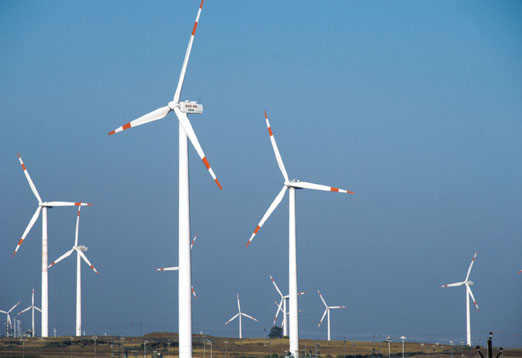
Suzlon wind turbines at work

Rs 3,300 crore is to be invested during the current fiscal to enhance its wind turbine and gear box manufacturing capacity - 2,500 of which will be in India and the rest in its subsidiary in Belgium, Hansen transmissions. Right now, Suzlon’s annual turbine output is 2,700 MW and they believe that will rise to 4,800 MW by the end of 2008.

Meanwhile, Suzlon’s bid for Repower AG hangs in the balance. The date to watch is the 24th May when all final bids have to be in. Will Suzlon raise it’s offer for Repower?

Will they join forces with Areva?

Will Areva seek to trump Suzlon?

Maybe Suzlon should bow out of this deal - the gain in Repower’s manufacturing capacity will be offset with their much lower margins and rightly or wrongly, one senses that the German company would be less willing to work with Suzlon than with Areva. My gut feeling is that they are better off expanding organically and buying key component manufacturers where necessary - the Hansen deal seems to have worked. How about a US tower manufacturer?

The costs of towers has been rising and ownership of a tower manufacturing plant could protect them from any further price increases.

E-mail Sign-up

Fill out the form below to receive the fornightly review AEI newsletter.

First Name
Last Name
E-mail