Archive for the ‘Solar’ Category

Sunpower Corp’s niche in solar tracking is delivering big projects

Tuesday, October 2nd, 2007

Sunpower Corp, one of a growing number of multi-billion dollar market cap solar companies, has just in the last week closed two deals to build a couple of megawatt class solar tracking power stations. The first is a megawatt class system for Agilent Technologies Inc. The system is expected to generate an estimated 1.8 million kilowatt-hours per year. For a solar system, that’s actually a very high annual output of power. My spreadsheet tells me that on average throughout the year this system will be producing 205 kilowatts of power, which corresponds to a load factor of 20.5% - excellent. That compares to about 10% for a solar pv system in West Germany.

The second system is very original 2 megawatts of solar trackers on a Korean Landfill site. Contrary to popular belief, landfill doesn’t take up that much space compared to the volumes that are tipped into it, but it is lost land to conventional development. So the use of solar panels over this otherwise useless space is intriguing.

Anyway, from a technological standpoint, solar tracking makes a great deal of sense. The sun does not conveniently shine at you from one angle throughout the day. It moves from East to West. So why not move the angle of the panels as the day progresses to take that into account?

Tracking can deliver up to 25 percent more energy than traditional fixed-tilt systems while reducing land-use requirements. That’s what solar tracking is all about and of the big solar companies, Sunpower Corp has a clear niche in this technology.

I’d much like to know though what the installed cost per watt of this technology is . . . I suspect it’s pretty expensive.
Chinese solar companies take action on silicon shortage

Monday, September 17th, 2007

It’s all too easy to overlook the complexity of the solar pv industry and talk about it collectively. The manufacturing end of the Solar PV industry in particular has several levels, with generally speaking, the highest margins at the top. Those levels are;

i) Those that make polysilicon

ii) Those that cut wafers from the said silicon

iii) Those that make solar cells from the wafers

iv) Those that make solar modules from the solar cells

(Here’s where I got the photo from by the way). Followers of this blog and of the solar industry in general will be well aware of the polysilicon supply crunch which is largely responsible for the non-fall in prices, so often predicted in recent years from increased production.

Well LDK Solar, a manufacturer of silicon wafers, has just come up with its own drastic answer to the polysilicon shortage, making it themselves. LDK expects to start production at 6,000 metric tons in the third quarter of 2008, rising to 15,000 tons in 2009 - a hell of a lot.

Meanwhile, China Sunergy, Chinese solar cell firm based in Nanjing, is so desperate for wafers that they are buying them from Taiwan. I say desperate because I suspect mainland Chinese officials would hate their high-tech industries to be seen to be dependent on Taiwan, for them a renegade province that should be under PRC control. If you want to know more about the Taiwanese solar industry, take a look at this excellent piece here.

The hard question though is how long will the silicon shortage last?

A few years ago, the optimists said 2008, today they say 2010. I’m going to stick my neck out and guess that it will be even longer than that - 2012. A lot more capacity needs to be created at the top end of the manufacturing chain and I don’t see that - yet.

The solar stock shakeout continues . . . with China Sunergy posting Q2 loss

Saturday, August 25th, 2007

A very interesting piece here by J. Peter Lynch - Solar Stocks plummet on market turmoil - (not THE Peter Lynch of Fidelity). J. Peter believes that solar stocks were “. . . over bought at the time the market woke up to the potential problems in the sub-prime and other credit markets. The combination of a rapidly falling market and an over extended solar market sector was not a pretty sight.”

Meanwhile, China Sunergy, has just posted a Q2 loss, with one analyst citing the global supply crunch of polysilicon as the main cause for the loss of $3.8 million, or 14 cents per ADS, after paying dividends to preferential stock holders.

A quick glance at the solar universe, suggests that solar stocks listed outside of America - the other 60% - are holding up pretty well. Europe’s solar cheerleader, Renewable Energy Corp, can point to second-quarter profits ahead of expectations at both the pretax and operating levels.

Will nanotech provide the cost breakthrough for solar power?

Monday, August 20th, 2007

Increasingly of late, I keep reading about nanotechnology being the key to solar power’s breakthrough. A good place to follow this sort of story by the way is here - a website dedicated to news about nanotech with a sizeable section on solar nanotechnology.

I know there is a constituency out there that believes that solar is some kind of miracle energy source just around the corner. There has indeed been a feverish following of nanotechnology since the publication of Eric Drexler’s 1986 book “Engines of Creation - the Coming Era of Nanotechnology“. Sorry to spoil the party, but there are however a few hard facts that can’t be ignored;

i) Today, solar photovoltaic power delivers a load factor of 10% in countries like Germany that can afford it.
ii) That’s because there is no solar power at night and actually very little during cloudy days and winters in Europe
iii) It’s a great mistake to concentrate on the manufacturing production cost per watt of this or that solar technology. In the long run, all that matters is the installed cost per watt and that remains high - $6 - $9 per watt.
iv) If you had the technology to produce solar power at a quarter of the cost of everyone else, would you sell it at that price too?
v) Solar power will not make the massive breakthrough until it reaches an installed cost of $1 - $2 per watt. Don’t bet on that happening any time soon.

In that vein, I have just started leafing through my well-worn copy of Ray Kurzweil’s “The Singularity is Near” again. A wonderfully optimistic book from a brilliant futurist who has a record of getting most things right. Yet looking at it again, I’m reminded that the world is full of broken promises about falling costs in solar power. On page 250 of the book, he quoted Martin Roscheisen of Nanosolar, who ” . . . estimates that his technology has the potential to bring down solar-power costs to around fifty cents per watt by 2006, lower than that of natural gas. Competitors Nanosys and Konarka have similar projections.”

Well, needless to say, this hasn’t happened. I tend to think there is far more potential in the medium term for Concentrated Solar Power (mirrors heating up molten salts in deserts), an off the shelf cheaper technology that works and delivers industrial quantities of power, especially in what the Economist recently labelled the Dark Continent - because at night, unlike other developed continents, almost the whole of Africa remains dark, unlit by electricity.

Thin Film PV - finally, are we on the cusp of a revolution?

Friday, August 10th, 2007

According to a report by NanoMarkets - which you probably won’t buy because it costs 1000s of dollars - the forecast rate of growth for thin film is way faster than that of the PV industry as a whole (put at 30 - 40% per annum, depending on who you believe). The world thin-film photovoltaics (TFPV) market is forecast to reach $7.2 billion by 2015 up from $1 billion today. A seven fold increase in 7 or so years is pretty amazing.

So after taking another look at our list of solar stocks here, I thought it would be helpful to list out separately, those solar players engaged in the business of thin film pv;

The Thin Film Solar PV Players

1. Daystar Technologies
2. Energy Conversion Devices
3. First Solar
4. PowerFilm Solar
5. Solar Integrated Technologies

What stands out to any solar industry observer, is that none of these companies are from Germany, or very involved in it - unusual, considering Germany is the mainstay of the global solar market. They also have next to no exposure to Chinese manufacturing, the solar low-cost manufacturing route.

That’s because thin film is a very high tech bet on a high tech industry. And Energy Conversion Devices, notably, failed to convert the technology into sales a few years ago. Now there are new players, including the unlisted Nanosolar which has the added PR benefit of investment by google founders.

In another 3 years, I think we’ll be able to see better how this all pans out and whether thin film will still be the future or as good as they say it is. It’s just that at about this point, many observers are anticipating a possible fall in silicon prices, negating the need for lower efficiency, although less costly thin film in the first place . . . ?

Ascent Solar reveals 99% of warrant exercised and the stock jumps

Thursday, June 28th, 2007

Enticingly named Ascent Solar, a maker of thin-film solar pv modules, said it expected to receive $21.6 million from the exercise of the warrants. The upshot of this was the stock soared over 15% on the 25th June, since when it has come off a little bit, dropping 5.36% yesterday.

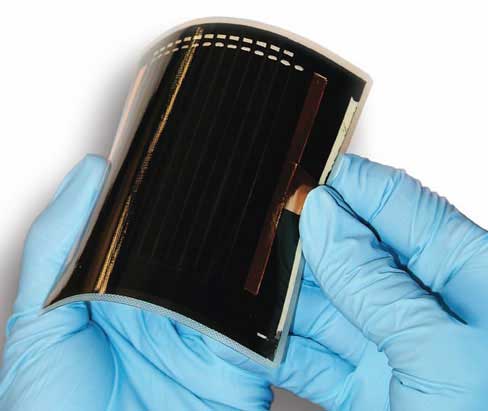
Ascent solar cell

Like several other thin film manufacturers, Ascent Solar believe they have the solution to lowering solar prices. Their techology uses a plastic film or substrate coated with thin-film PV. As this picture shows, it is flexible and light weight. But does that really matter?

A solar airship

Not for buildings, but very conceivably for flight. Like this solar-powered blimp made by
Lockheed Martin HAA. Lighter-than-air, solar-powered High-Altitude Airship is designed to hover for more than a year at 60,000 ft. A prototype is scheduled to go aloft in 2010.

2 new solar stocks on AEI

Friday, June 22nd, 2007

Following a couple of IPOs over the last week, here they are;

PV Crystalox - a company in what I regard as the sweetspot of the solar business, a manufacturer of silicon ingots and wafers

and

Solaria Energia - a Spanish PV company, which disappointingly, only carries the Spanish language on its website. There has been a bit of a buzz about Spain becoming the next Germany in solar power - that’s why several German firms were keen to open subsidiaries there over the last year or so. And yet, you have to think that a Spanish supplier ought to have more opportunity to exploit that over a German one. Let’s see. A friend of mine incidentally with a large holiday home in Spain, was advised not to install solar pv panels, because they would be stolen. If that’s really the case, the millions of holiday homes (800,000 built last year alone) there will not be a market and the growth will most likely have to be Spanish-led or more ways than one.

New solar stocks on AEI . . . meanwhile is a solar crash in the offing?

Saturday, June 9th, 2007

As promised a little while back, here they are;

China Sunergy - a Nanjing-based solar cell manufacturer which floated on May 18th and LDK Solar which went public a few days ago.

Is there no end to the Chinese Solar boom?

Here’s a man who thinks a more general solar correction is in sight - J. Peter Lynch. As he wrote recently here . . .

“Back in September and October of 2006 all of the publicly traded solar stocks I follow regularly (15 in the U.S. and 12 in Germany) were just advancing through their 50 day moving averages. Currently, 12 of 15 (80%) of U.S. solar stocks are below their 50 day average and 9 of 12 (75%) of German stocks are below their 50 day average. This tells me that, more than likely, the solar sector is weakening and is potentially headed for a corrective phase“.

Added to this, I think some of the stories we have been seeing lately about polysilicon oversupply bringing down prices as soon as 2010 are at least a little overplayed. There is still massive undersupply which may necessitate some consolidation in the industry - that just might play out after a mini solar crash as is anticipated by Lynch.

Congratulations to the crew of Sun 21

Thursday, May 10th, 2007

The Atlantic has been rowed, powerboated and even swam across, but just 2 days ago, the first solar-powered crossing was made by Sun 21.

Sun21 reaches NY

The achievement of course is not so much physical as technological. Sitting on this boat and pointing it in the right direction is about as tough as it gets - or so I imagine. The boat has 10 kilowatts of solar modules and is driven by 2 electric motors, of 8 kW each. Solar power is stored for overnight progress using batteries.

It doesn’t even seem to be that expensive - about 700,000 Swiss Francs or $854,000 it is within the price range of a brand new sailing yacht, achieving the same speed without all the effort.

I was actually a bit surprised that they had to pack in 760 litres of fresh water to keep them going. Surely they could have tapped into some of that solar power for desalination?

RBC report makes case for solar breakthrough by 2012-2014

Thursday, May 10th, 2007

RBC Capital Markets yesterday released a new report;

Here comes the Sun

a bit of a clichéd title, which makes you think of this Beatles song

The report is by Stuart Bush, their lead alternative energy equity analyst for RBC Capital Markets.

It makes the following recommendations for solar investors which I have abbreviated below;

* Play the Supply Chain: e.g. silicon, wafer and cell producers will generate higher margins than the labor-heavy and low barrier-to-entry module and installation segments.

* Play Tech Differentiation: companies with higher efficiency products or lower-cost thin-film designs are better suited to command superior profits long term.

* Play Globally: An investment strategy that seeks to pair Asian producers long versus European producers will benefit in the long term.

* Play within a Geography: Investing among companies located in particular regions, such as Germany or China, will limit exposure to cross-border macro trends and highlight comparably strong regional producers.

Here are two other points it makes which I think are very interesting;

i) The forecast for thin-film solar growing from 6.5 per cent of the market in 2007 to 19 per cent in 2011 - a real turnaround if this happens, as this is a technology that has not delivered anything its promise thus far
ii) the total industry average installed cost for photovoltaic solar will decline from about $7.37 per kilowatt in 2007 to about $4.40 in 2011, and achieve organic competitiveness with grid electricity at about $3.50 per kilowatt, without incentives and depending on the region in 2012-2014 - this really is quite optimistic, I think a 30% drop over the next 10 years to 2017 is more likely, but who really, really knows?

And let’s face it, even if solar prices continue not to fall, the technology will at least reduce in real terms, on the tide of rising incomes.

E-mail Sign-up

Fill out the form below to receive the fornightly review AEI newsletter.

First Name
Last Name
E-mail